

Webinar: Embedding ICN Nursing Definitions into Global Regulation
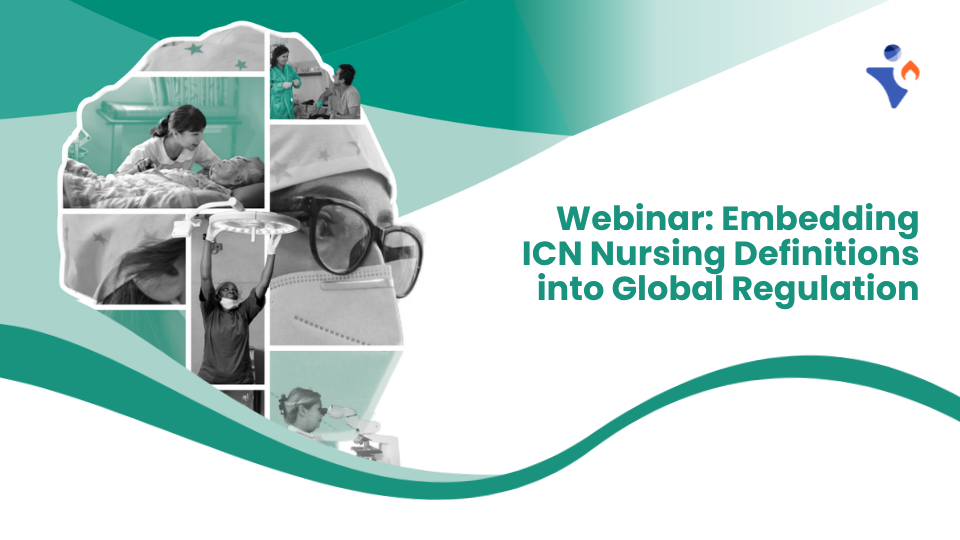
ICN has released updated global Definitions of Nursing and of a Nurse, marking an important milestone in clarifying the nature, purpose and boundaries of the profession worldwide. These definitions provide a shared foundation for understanding nursing roles, informing regulation, education and workforce planning, and supporting coherent scope‑of‑practice decisions across diverse legal and policy environments.
As health systems face increasing complexity, evolving models of care and persistent workforce pressures, many regulatory frameworks remain fragmented or misaligned with contemporary practice. This webinar explored how the ICN Definitions can serve as a foundation for modern, capability‑based approaches to nursing regulation, examining their relevance for scope of practice, governance, education, accreditation, workforce sustainability and professional wellbeing.
Watch the webinar recording here
Speakers
-
Dr José Luis Cobos Serrano – President, International Council of Nurses
-
Dr Michelle Gunn – Head of Practice and Regulations, ICN
-
Professor Jill White - Chair, Definition of Nursing Project
-
Professor Mary Chiarella – Nursing and health regulation expert
-
Dr Phil Dickison – CEO, National Council of State Boards of Nursing
-
Professor Sun Rae Shin - Previous ICN Board Member
-
Mr Felipe Cortes Leddy – Chief Nurse Officer
-
Mr Howard Catton – Chief Executive Officer, ICN
Presentations
A global foundation for the profession
Dr José Luis Cobos Serrano, ICN President, emphasised the significance of the new definitions at a time of growing complexity in health systems and rising expectations of nurses.
“Definitions are far more than words on a page. They are a compass that helps frame our professional identity and guide the future of nursing.”
Dr Michelle Gunn, ICN Head of Practice and Regulation, outlined how the definitions provide a shared reference point for understanding nursing across diverse settings, moving beyond fragmented, task-based descriptions.
“The definitions give us a common reference point, a way to clearly say: this is nursing.”
A globally developed definition
Professor Jill White, Chair of the ICN Definition of Nursing Project. explained the extensive global consultation underpinning the new definitions, including literature review, stakeholder engagement and a Delphi expert process.
“This is truly a global, evidence-informed definition. Nurses told us they felt seen for the first time.”
From tasks to capability
Professor Mary Chiarella, nursing and health regulation expert (Australia), challenged traditional task-based models of regulation, arguing for a shift towards capability-based approaches grounded in professional judgement.
“Nursing cannot be understood or regulated as a list of tasks. It is defined by knowledge, judgement and accountability.”
Making definitions operational
Dr Phil Dickison, CEO of the National Council of State Boards of Nursing (USA), explained how definitions underpin safe and consistent practice across jurisdictions. He introduced practical tools such as a “definition gate” to ensure all regulatory decisions align with the purpose and function of nursing.
“Without a shared definition, regulators cannot ensure consistent, safe practice across jurisdictions.”
Implications for education and accreditation
Professor Sung Rae Shin, former ICN Board Member (Republic of Korea), highlighted the need for education systems to align with the expanded scope reflected in the new definitions.
“How we define nursing directly influences what nurses are expected to know and how they are prepared.”
Strengthening identity and wellbeing
Mr Felipe Cortés Leddy, Chief Nursing Officer (Chile), emphasised the interconnectedness of regulation, professional identity and nurse wellbeing. He highlighted the importance of strong regulatory frameworks alongside investment in working conditions and leadership.
“These are not isolated elements. They form an interdependent system that shapes the sustainability of health systems.”
A defining moment for the profession
Mr Howard Catton, ICN Chief Executive Officer, described the new definitions as a pivotal opportunity for the profession. He called on regulators, educators and policymakers to actively embed the definitions into practice, education and policy frameworks.
“Our failure to define ourselves has allowed others to define us. This is a moment to take control of our profession.”
Objectives
-
Build a shared understanding of the ICN Definitions of ‘Nursing’ and of ‘a Nurse’ and their importance as foundational reference points for the profession and for modern approaches to nursing regulation.
-
Explore the relationship between professional definitions and scope of nursing practice, including how clear definitions support safe, accountable and context-appropriate scope decisions.
-
Examine the transition from task-based regulatory models to capability-based approaches, and consider how professional judgement, competence and education underpin contemporary nursing practice.
-
Strengthen understanding of how regulators, professional bodies and health system leaders can address complex regulatory challenges in evolving models of care, including the design of coherent regulatory systems.
Outcomes
After this webinar, participants:
- Strengthened their understanding of the ICN Definitions of Nursing and a Nurse as foundational reference points for regulation, education, and professional practice.
- Explored how clear, shared definitions support coherent scope‑of‑practice and capability‑based regulatory approaches across diverse health system contexts.
- Examined the transition from task‑based to capability‑based regulation, highlighting the role of professional judgement, education, and accountability in safe practice.
- Gained insights into practical tools and frameworks for embedding nursing definitions into regulatory systems to strengthen public protection and consistency.
- Recognised the links between regulation, education, professional identity, and workforce wellbeing in sustaining nursing practice and health system resilience.
- Identified opportunities for greater global alignment and collaboration in regulation, accreditation, and policy while respecting national and regional contexts.