

ICN condemns normalization of attacks and violations of nursing neutrality documented in devastating SHCC report
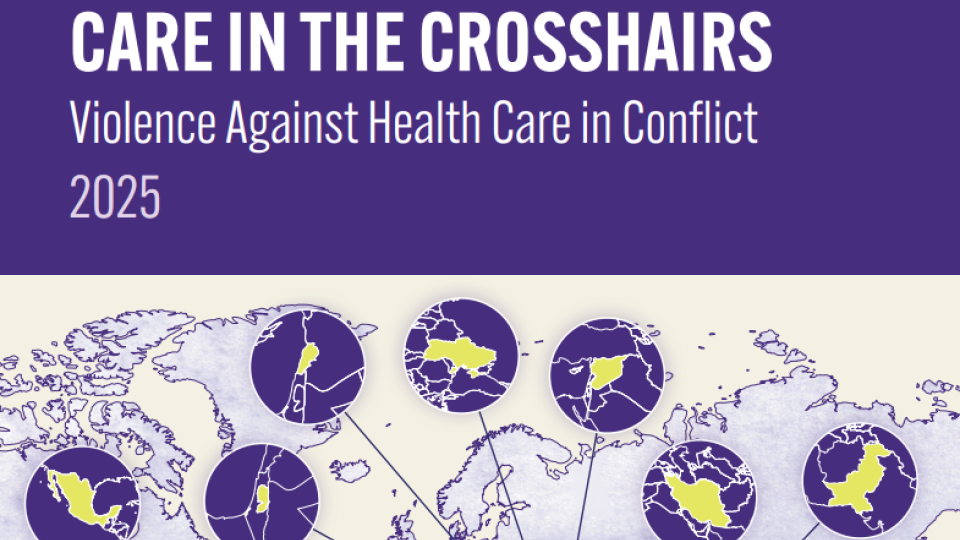
The International Council of Nurses (ICN) responds with grave concern to the publication of the Safeguarding Health in Conflict Coalition's (SHCC) annual report, Care in the Crosshairs, which documents relentless and escalating violence against health care workers, facilities, and patients across 33 countries and territories in 2025.
The report records 2,546 horrific attacks on health care in 2025, including data showing 455 health workers killed, 218 kidnapped, 263 arrested or detained, and 790 incidents of damage or destruction of health facilities. ICN deplores the unacceptable and unconscionable targeting of health personnel and is particularly alarmed by the scale of kidnappings (which have increased) as well as arrests/detentions, which can subject health workers to torture, prolonged psychological harm, and violence, and which often punish health workers for upholding their ethical duty to provide impartial care to all.
ICN is also gravely concerned by the data showing an alarming surge in drone-related attacks and a drastic increase in attacks perpetrated by state actors, which now account for 64% of all incidents. This indicates dangerous escalations in the methods, scale, and nature of violence directed at health care, with important implications for the implementation of International Humanitarian Law (IHL) to protect health workers.
ICN is a founding member of the SHCC and contributed to the report, with ICN's Senior Policy Adviser Hoi Shan Fokeladeh on the SHCC Steering Committee. Through #NursesforPeace and other work, ICN continues to advocate in the strongest terms for the protection of health care in conflict: read about our recent work.
ICN President José Luis Cobos Serrano condemned the catastrophic normalization of violence against health care and demanded action and accountability:
“At great personal risk, in every conflict, in every crisis, nurses bring hope and healing and protect health systems. Yet this report documents heartbreaking and unacceptable violence, with nurses and health workers being tragically killed, harmed, intimidated, kidnapped, arrested, and subjected to sexual violence.
‘The devastating figures in the SHCC report confirm exactly what ICN has been warning about for years: the catastrophic normalization of attacks on health care in conflict is driving ever-escalating violence and impunity. At the World Health Assembly last week, WHO Director-General Dr Tedros described attacks on health care as the 'alarming and illegal new normal in conflict’ — a reality ICN has long been raising the alarm on.
'During my time in Geneva for the World Health Assembly, ICN First Vice President Sineva Ribeiro and I had the opportunity to speak directly with Dr Tedros and we conveyed in the strongest terms the urgent need to act in defence of nurses and all health workers in conflict zones.
‘ICN is in constant contact with National Nursing Associations in conflict-affected regions and we are continually hearing firsthand and harrowing accounts of nurses who go to work to save lives and never come home, of the immense psychological toll of working under bombardment and witnessing atrocities, of nurses losing colleagues and seeing health facilities destroyed around them.
This cannot continue. No nurse should ever be a target. ICN recently highlighted in our IND report how nurses bring the “Power of Peace”: they heal communities, protect health systems, and rebuild after conflict. We will continue to stand with nurses in conflict through our #NursesforPeace initiative and advocacy. We will not stop calling for the attacks to end, for full accountability, and for every nurse, health worker, and patient to be protected.”
Speaking at the Swiss Nurses’ Congress, where he delivered a keynote speech on Nursing and Peace, ICN CEO Howard Catton condemned these escalating attacks and said that nurses act as human rights defenders and peacemakers as well as health makers in the most challenging conflict situations. In response to the SHCC report, he warned that a decade after Resolution 2286, the world is failing health workers and said nurses are being punished for fulfilling their ethical duty to provide care, saying:
“This year marks the tenth anniversary of the adoption of UN Security Council Resolution 2286, which reaffirmed obligations under International Humanitarian Law to respect and protect health personnel, patients, facilities, and medical transport. A decade later, this report shows that the world is failing to meet these obligations and failing to protect health workers, facilities, and communities in conflict. Every violation of IHL is an attack on humanity itself. When nurses are killed, when hospitals are destroyed, entire communities lose access to life-saving care. We are also seeing a failure to protect health workers in public health emergencies as well as conflict, with nurses on the frontlines of the Ebola crisis fearful for their safety and lacking PPE, as ICN has reported.
‘The ICN Code of Ethics is clear: nurses have a fundamental responsibility to provide care to all people in need, regardless of the setting and without discrimination on the basis of nationality, ethnicity, political affiliation, or any other factor. That is the principle of nursing neutrality. But we are seeing nurses and health workers punished for doing exactly what their professional and ethical duty demands. In some cases, health workers may be understood by parties to a conflict as supporting the 'enemy' when they are doing nothing more than upholding their ethical duty by providing impartial care to all. The scale of attacks, kidnappings, and arrests represents a deeply worrying escalation designed to militarize health care and to sow fear among health workers. This is an assault on the foundational ethical principles of nursing and medicine and demands urgent action. We cannot allow nurses to lose their lives or be detained or arrested for providing care. We have the resolutions and frameworks. What is needed now is immediate and full enforcement.”
ICN calls for:
- An immediate end to all attacks on health care
- Full accountability including prompt independent investigation of all attacks and the enforcement of International Humanitarian Law
- Protection and structural empowerment of nurses and health workers who risk their lives in conflict, including protection from all violence under IHL, safe working conditions, adequate PPE and emergency response training, fair compensation, psychosocial support, and leadership roles.
- Member State reporting on attacks on health care, as required under Resolution 2286
- Standardized data collection and monitoring of attacks on health care, including expanding reporting in hard-to-reach settings and including a range of sources
- Sustained humanitarian funding to support health system recovery, protect health workers, and ensure continuity of care in conflict-affected regions.
Read more on ICN’s recent work advocating against attacks on health care in conflict and promoting the nursing Power of Peace, including:
- #NursesforPeace initiative and ongoing humanitarian work (see latest update)
- ICN's reporting on nursing in conflict to the UN High Commissioner for Human Rights and UN Special Rapporteur and direct calls to the UN Secretary-General
- Strong calls for protection of health workers at last week’s World Health Assembly
- Recent keynote presentations on nursing, conflict, and peace at the centre of National Nursing Congresses
The full SHCC 2025 report, Care in the Crosshairs, is available at: https://shcc.pub/SHCCAnnualReport2025
Insecurity Insight's interactive map tracking attacks on health care globally is available at: https://maps.insecurityinsight.org/